Case Study 001 — Self-Implementation
Before we offer it to anyone else, we run it on ourselves.
Covered — June 2026
Before Covered could honestly offer an AI Workflow Audit to a client, we needed to answer one question: does this process actually work — and can we say so honestly?
Consulting services that have never run their own methodology carry a specific kind of credibility risk. Not incompetence. Untestedness. The offer sounds right, but it has not been pressure-tested on a real workflow.
We decided to close that gap by running the process on ourselves first.
The process
Covered applied its AI Workflow Audit process to its own service delivery model — specifically, how we take a prospect from initial inquiry to a delivered readiness blueprint.
The audit followed the same process designed for this engagement:
Step 1 — Initial Intake
We documented how a prospect would currently discover and engage with Covered. We identified what information we’d need to assess fit and begin a meaningful conversation.
Step 2 — Fit Review
We applied a structured evaluation against our target client profile: a small business owner or solopreneur who wants AI to enter their workflow without handing over operational control. We assessed whether the offer was designed for the right person — and whether the criteria for a good fit were written down somewhere a practitioner could use them.
Step 3 — Workflow Session
We mapped the actual service delivery workflow — nine stages from first inquiry to engagement close. The mapping was candid. We included the gaps, not just the designed flow.
Step 4 — AI Opportunity Assessment
We assessed each stage for AI fit: where AI reduces friction, where it should not be used, and where human review is non-negotiable. We identified five integration opportunities — all with explicit human review gates — and six stages where AI should not touch the work, including final judgment calls, direct client communication, and pricing conversations.
Step 5 — Human Review
Before the blueprint was produced, the assessment was reviewed for accuracy and honest scope. The limitations were named directly, not buried.
Step 6 — Blueprint Delivery
We produced the full deliverable: workflow summary, friction points, AI-fit opportunities, where AI should not be used, human review points, a prioritized list, and next-step recommendations.
Step 7 — Clarification and Close
We reviewed the output against the original intent and made one round of refinements.
The outcome
The assessment found that the offer design is sound. The target client is real. The problem — wanting AI’s efficiency without losing operational control — is a recognized barrier in small business adoption, not a manufactured pain point. The value of a structured audit holds even if the client never implements a single automation.
The audit also surfaced four gaps. We resolved them before asking anyone to pay for the process:
- No live intake path. A prospect with interest had nowhere obvious to go. We defined the intake path this article now points to.
- No bounded deliverable definition. The audit was clear conceptually but not dimensionally. We locked the definition and the seven-section structure.
- No engagement ceiling. Without a defined timeline and revision policy, scope creep was the primary risk. We locked both.
- No risk disclosure. What an audit can and cannot do — and what the client is responsible for verifying — was implicit, not explicit. We wrote it into the blueprint itself.
What we learned
Clarity comes from running the process, not planning it. The offer was conceptually defined before this audit. It was operationally clear only after. The gaps that surfaced were not visible from the planning layer — they required actually mapping the workflow honestly and asking whether a practitioner could perform each stage with integrity.
Restraint is part of the value.The section of the blueprint that names where AI should not be used is not a caveat. It is one of the most useful outputs. A client who leaves with a clear picture of where AI helps and where it would harm their workflow has received more honest value than one who receives an “AI everywhere” recommendation.
The blueprint is the deliverable, not the automation.The client’s outcome is clarity — a structured, honest assessment of their workflow and a prioritized list of what to change, when, and why. Whether they implement anything is their decision. The value does not depend on it.
Testing your own offer is the correct first move. Not because it proves the offer works for clients — that requires real client engagements. But it proves the practitioner has walked the process honestly, encountered the gaps, and addressed them before asking anyone else to trust them.
The service flow
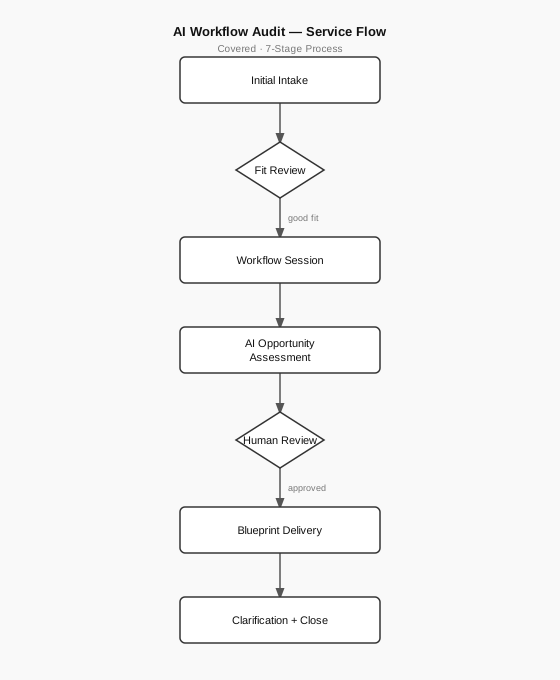
Seven stages. Two review gates. Every output reviewed by the practitioner before it reaches the client.
About this engagement
The AI Workflow Audit + Readiness Blueprint is designed for small business owners and solopreneurs who want AI to enter their workflow without handing over operational control.
What you receive
A written review of your current workflow, identifying where AI can help, where it should not be used, and a prioritized readiness blueprint with human review points built in.
What is included
Current workflow summary · Friction point identification · AI-fit opportunities · Where AI should not be used · Human review and approval points · Prioritized readiness blueprint · Next-step recommendations
What is not included
Custom software build · Automation deployment · Ongoing management · Legal, financial, or medical advice · Guaranteed results
How it works
One intake session. Blueprint delivered within five business days. One delivery walkthrough. One round of written clarification.
Interested in this for your business?
Start a project inquiry through Covered’s contact page and tell us what part of your workflow feels repetitive, slow, or hard to manage.
Start a project inquiry